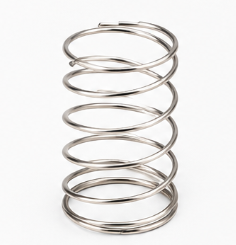
Ideal calculations assume coaxial loading, while real assemblies contain eccentricity, uneven ends and clearance that can trigger lateral instability.
Geometry gives the first warning
A long free length relative to diameter makes lateral movement more likely during compression. Support condition and working travel also influence the critical state.
Ends control support stability
End coils, grinding, squareness and platen parallelism determine how evenly load enters the spring. Unstable ends can initiate bowing early.
Use internal or external guidance thoughtfully
Rods and sleeves constrain lateral motion but need allowance for diameter tolerance, dynamic change and lubrication. Tight guidance creates friction and wear.
Read the failure marks
One-sided rub marks, polished areas or localized fracture point toward guidance, eccentricity, ends or assembly posture rather than material strength alone.
References
This article is informed by public standards catalogues and industry engineering resources. Project values should be confirmed by drawings, material certificates and sample validation.