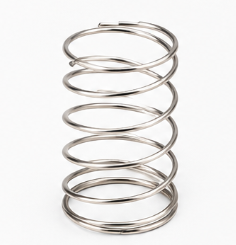
DESIGN WINDOWTypical capability range
Use these values for early selection. Final dimensions, tolerances and loads are confirmed by engineering review and approved samples.
- Wire Dia
- 0.1-20mm
- OD
- 1-200mm
- Free Length
- 2-500mm
- Typical use
- Widely used in molds, machinery, electronics, automotive industries
ENGINEERING OPTIONS
Materials, forms and quality controls
01Material options
- Music wire: high-strength precision compression springs
- SUS304 / SUS316: corrosion and clean environments
- 65Mn / 60Si2Mn: general industrial and higher-load uses
02Forms and processes
- Open, closed and closed-ground ends
- Constant or variable pitch and resonance control
- Cylindrical, barrel and rod / sleeve guided forms
03Critical inspection
- Free length, outside / inside diameter and squareness
- Load at one or two specified heights
- Solid height, recovery and fatigue life
APPLICATION FIT
Typical applications
Various compression springs, ground or closed ends, suitable for molds and machinery
01Machinery and dies
Valves, fixtures, dies and automation return.
02Automotive mechanisms
Seats, switches, latches and controls.
03Electronics and instruments
Buttons, contacts, isolation and precision loading.
DESIGN NOTESEngineering notes
Slender springs need buckling and guide-clearance review. Uneven ends or eccentric assembly adds friction and local stress.
Preserve margin above solid height and use an independent hard stop. Repeated coil bind increases load, noise and fatigue risk.
RFQ CHECKLISTInclude with your RFQ
- 01 Wire, outside / inside diameter and free length
- 02 Total / active coils and end form
- 03 Working heights and loads
- 04 Minimum height, guidance and life
- 05 Material, finish and volume
Request Engineering Review → FAQ
Common design questions
Why provide two load points? +
Two points define working force and rate, reducing ambiguity from free-length or preload variation.
Do compression spring ends always need grinding? +
No. Grinding improves support and squareness but adds processing and cost. Select it from mounting needs.