DESIGN WINDOWTypical capability range
Use these values for early selection. Final dimensions, tolerances and loads are confirmed by engineering review and approved samples.
- Wire Dia
- 0.2-10mm
- Large End
- 5-150mm
- Small End
- 2-80mm
- Typical use
- Suitable for damping devices, battery contacts, electronic equipment
ENGINEERING OPTIONS
Materials, forms and quality controls
01Material options
- Music wire / 65Mn: machinery and damping
- SUS304: electronics, battery and humid service
- Copper alloys: special conductive-contact projects
02Forms and processes
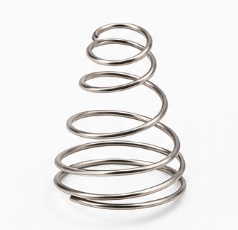
- Conical, tapered and variable-diameter forms
- Telescoping or non-telescoping coils
- Closed, ground or special large / small ends
03Critical inspection
- Large / small diameters, height and concentricity
- Loads at multiple working heights
- Nesting sequence, solid height and recovery
APPLICATION FIT
Typical applications
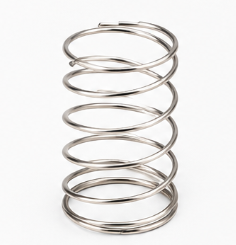
Conical tapered springs with stability, suitable for damping and battery contacts
01Compact mechanisms
Low solid height in limited axial space.
02Damping
Progressive rate or stable support components.
03Conductive contacts
Conical battery contacts in electronics.
DESIGN NOTESEngineering notes
Telescoping requires adjacent diameters to clear wire, forming tolerance and finish thickness.
As coils contact, active count changes and the load curve may become nonlinear. Use multiple points to define the range.
RFQ CHECKLISTInclude with your RFQ
- 01 Wire, end diameters and free height
- 02 Coils, pitch and nesting requirement
- 03 Orientation and support dimensions
- 04 Multiple heights and loads
- 05 Conductivity, finish and life
Request Engineering Review → FAQ
Common design questions
Is a conical spring always more stable? +
No. Support, eccentricity, pitch and travel also control stability and must be assessed in the mechanism.
Can every coil telescope? +
Some designs can, but adjacent diameter, wire and tolerance must be checked and the sequence validated on samples.