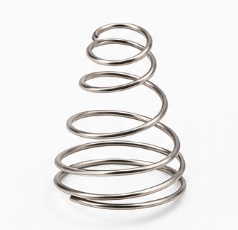
A compression spring reaches solid condition when its coils contact. Repeated impact at solid can add stress, noise, wear and permanent set.
Total coils are not active coils
End coils used for support do not deform like the central working coils. The end configuration must match the coil-count definition used in calculations and drawings.
Physical parts vary from theory
Wire diameter, pitch, ends and accumulated forming error affect actual solid height. Preserve margin for manufacturing and assembly variation.
Do not use the spring as a hard stop
If the mechanism needs a hard limit, use a separate feature to carry impact. Repeated coil bind causes a steep load increase and can reduce fatigue life.
Special case for conical springs
Some conical springs telescope adjacent coils for a lower height, but the nesting sequence, diameter steps and moving clearance must be validated on samples.
References
This article is informed by public standards catalogues and industry engineering resources. Project values should be confirmed by drawings, material certificates and sample validation.